


MINPA Overview
Mars Ion and Neutral Particle Analyzer for Mars Environmental Exploration
Measuring Ions and Energetic Neutral Atoms to Understand Solar Wind–Mars Interactions
Mars Ion and Neutral Particle Analyzer (MINPA)
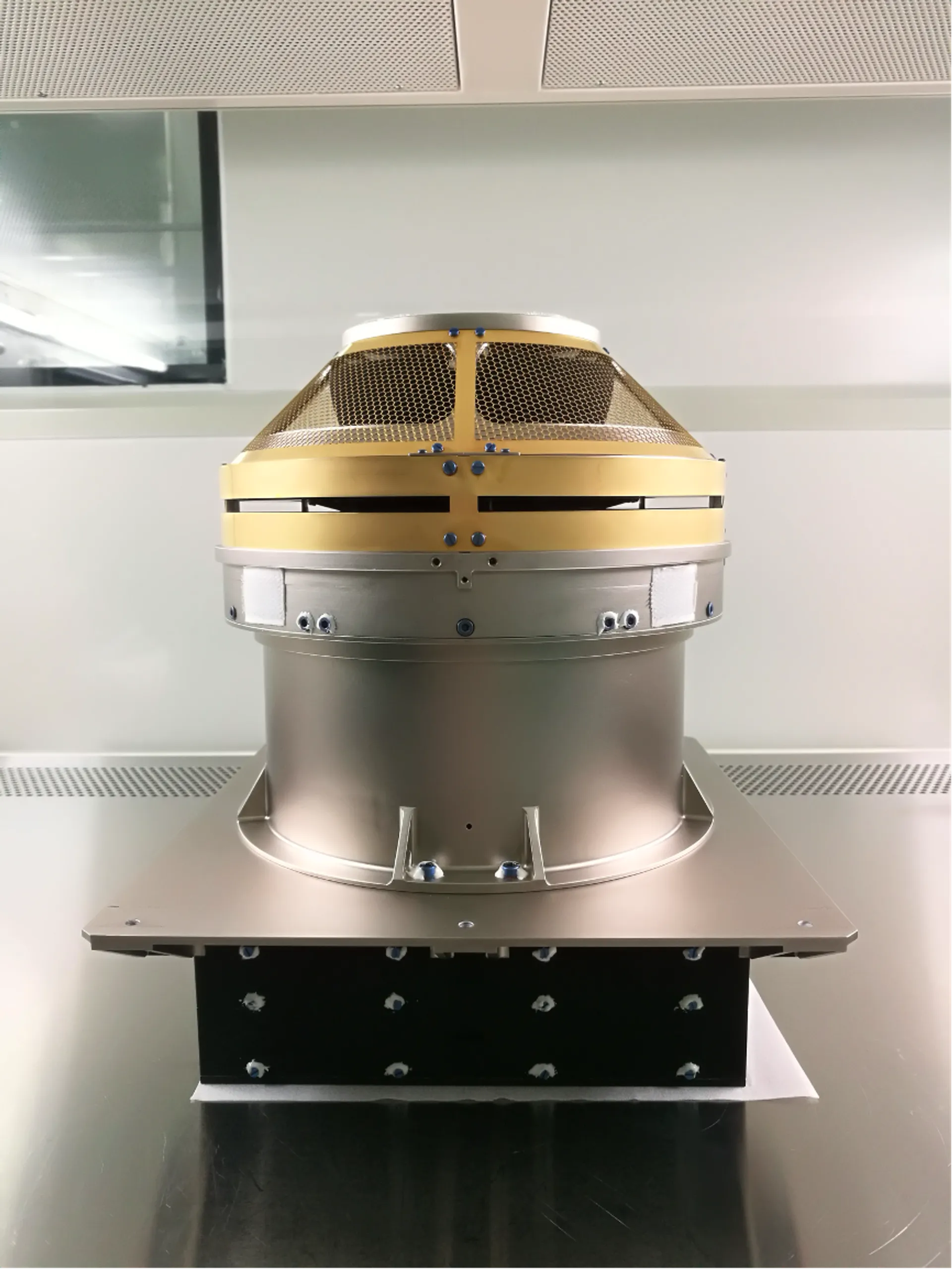
The main objective of the Mars Ion and Neutral Particle Analyzer (MINPA) aboard the Chinese Mars Exploration Mission (Tianwen-1) is to study the solar wind–Mars interaction by measuring the ions and energetic neutral atoms (ENAs) near Mars.
MINPA utilizes a standard toroidal top-hat electrostatic analyzer (ESA) followed by a time-of-flight (TOF) unit to provide measurement of ions with energies from 2.8 eV to 25.9 keV and ENAs from 50 eV to 3 keV with a base time resolution of 4 seconds. Highly polished silicon single crystal substrates with an Al₂O₃ film coating are used to ionize ENAs into positive ions. These ions can then be measured by the ESA and TOF to determine the energies and masses of the ambient ENAs.
The MINPA provides a 360° × 90° field of view (FOV) with 22.5° × 5.4° angular resolution for ion measurement, and a 360° × 9.7° FOV with 22.5° × 9.7° angular resolution for ENA measurement.
The TOF unit combines a –15 kV acceleration high voltage with ultra-thin carbon foils to resolve H⁺, He²⁺, He⁺, O⁺, O₂⁺, and CO₂⁺ for ion measurement and to resolve H and O (≥ 16 amu group) ENAs.
MINPA mounting and angle definition
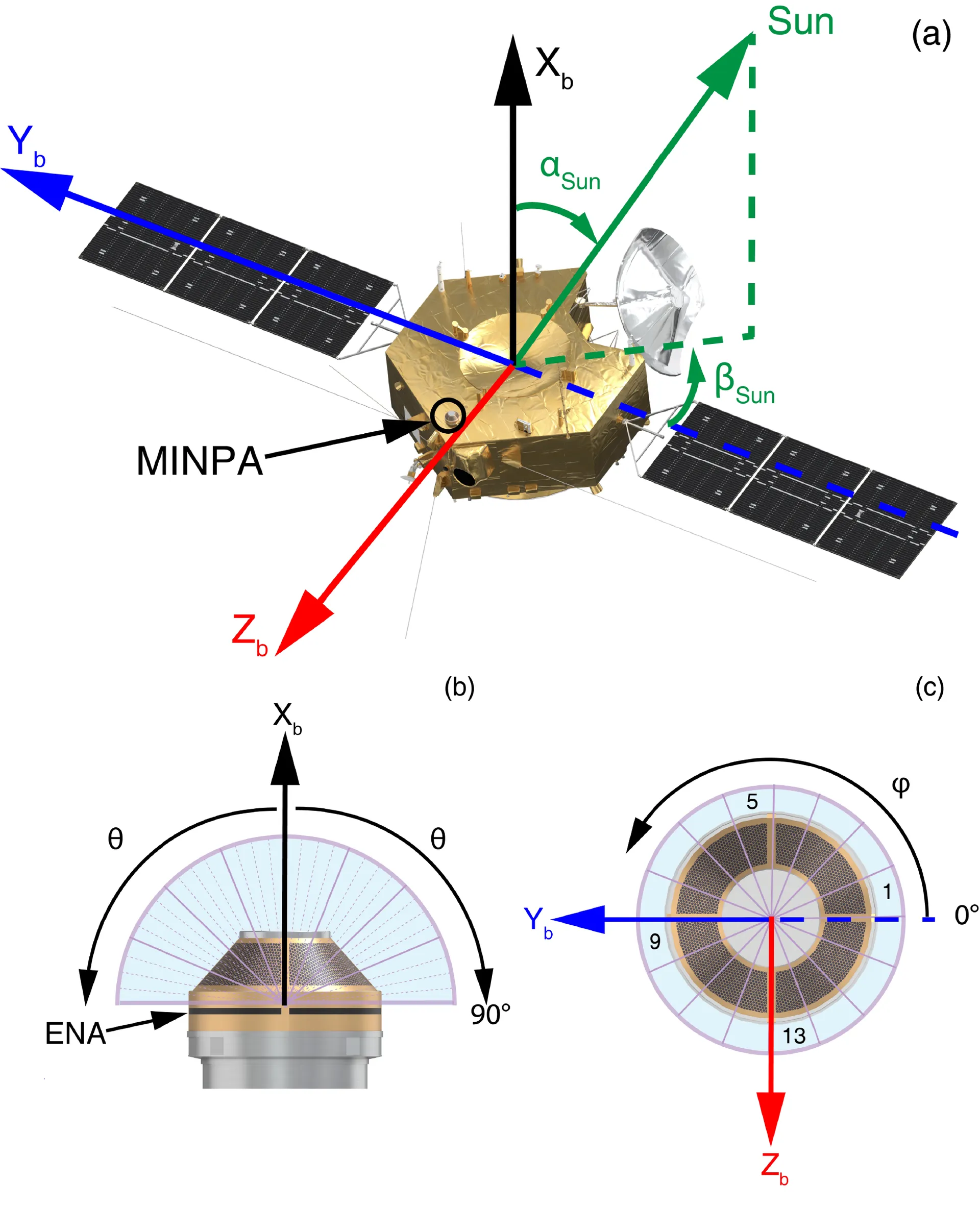
Tianwen-1 orbiter and MINPA. (a) Tianwen-1 orbiter and the illustrations of the solar incident angle (ɑSun) and solar azimuth angle (βSun) relative to the spacecraft coordinates (Xb, Yb, Zb). MINPA is mounted on the +Zb corner.
(b) Side and (c) top views of MINPA, with the illustrations of the instrument polar (Φ) and azimuth (φ) angles.
Here, ɑSun = sia, βSun = (270° − saa) mod 360°, θ = 90° − θ′, and φ = 360° − φ′, where sia, saa, θ′, and φ′ are the solar incident angle, solar azimuth angle, MINPA elevation angle, and azimuth angle used in the Level 2B (2B) data.
Coordinate system and angle definitions:
ɑSun = sia
βSun = (270° − saa) mod 360°
θ = 90° − θ′
φ = 360° − φ′
In-flight operation
Earth-Mars transfer orbit
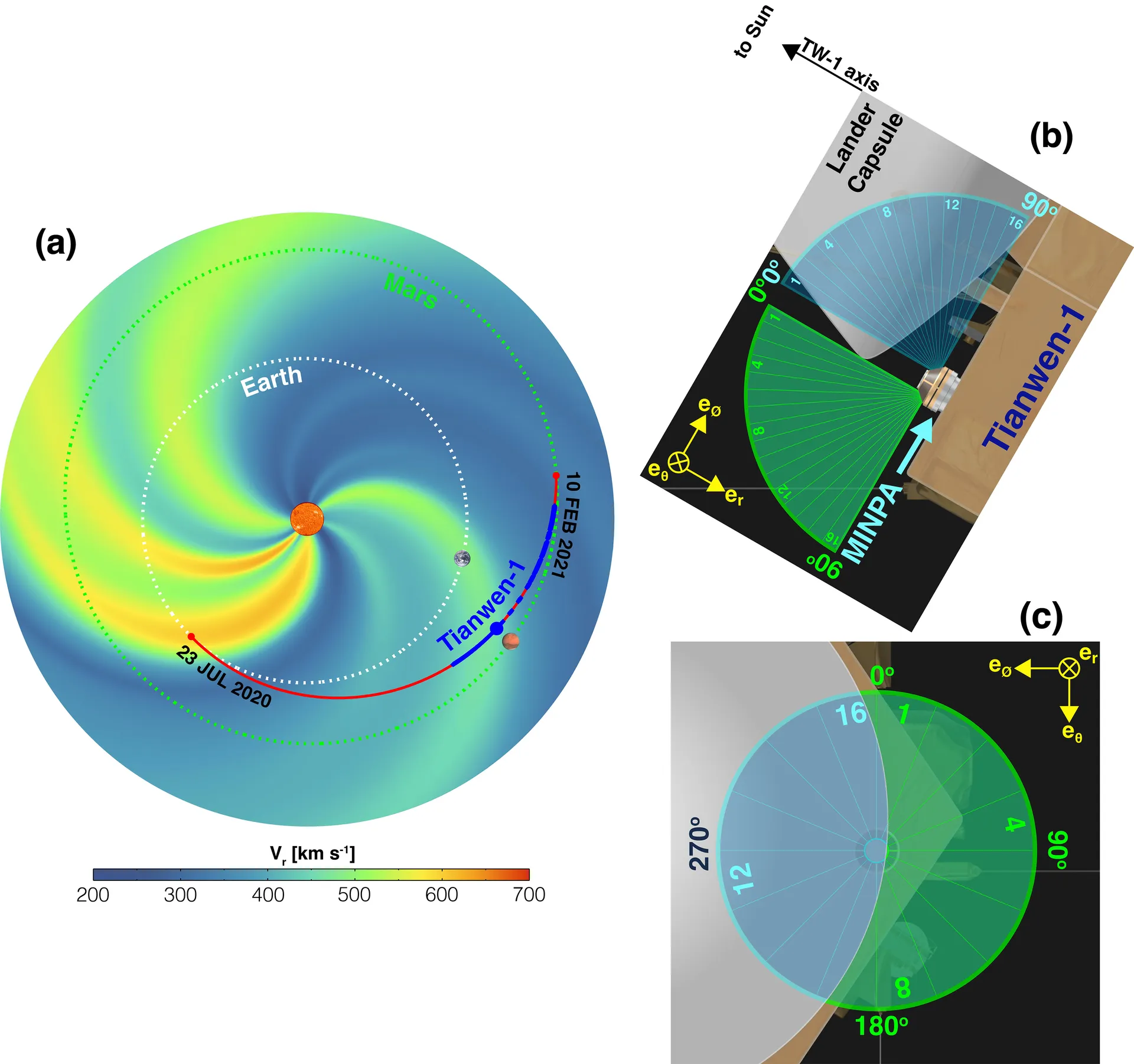
(a)Illustration of MINPA operations in solar wind in Heliographic Inertial (HGI) coordinates. Background colors show the solar-wind radial velocity Vr on the solar equatorial plane at 15:00 UTC on 23 November 2020, and the locations of Earth, Tianwen-1 (blue circle), and Mars at this time are also marked. The red curve denotes Tianwen-1’s transfer orbit, while the blue curves represent the MINPA operation in solar wind.
(b) Top view (from north to south) and (c) view from Sun towards Tianwen-1. The green and blue shadows denote the unblocked and blocked FOVs, respectively, and nearly half of them are blocked by the lander capsule.
Mars Orbit Scientific Exploration
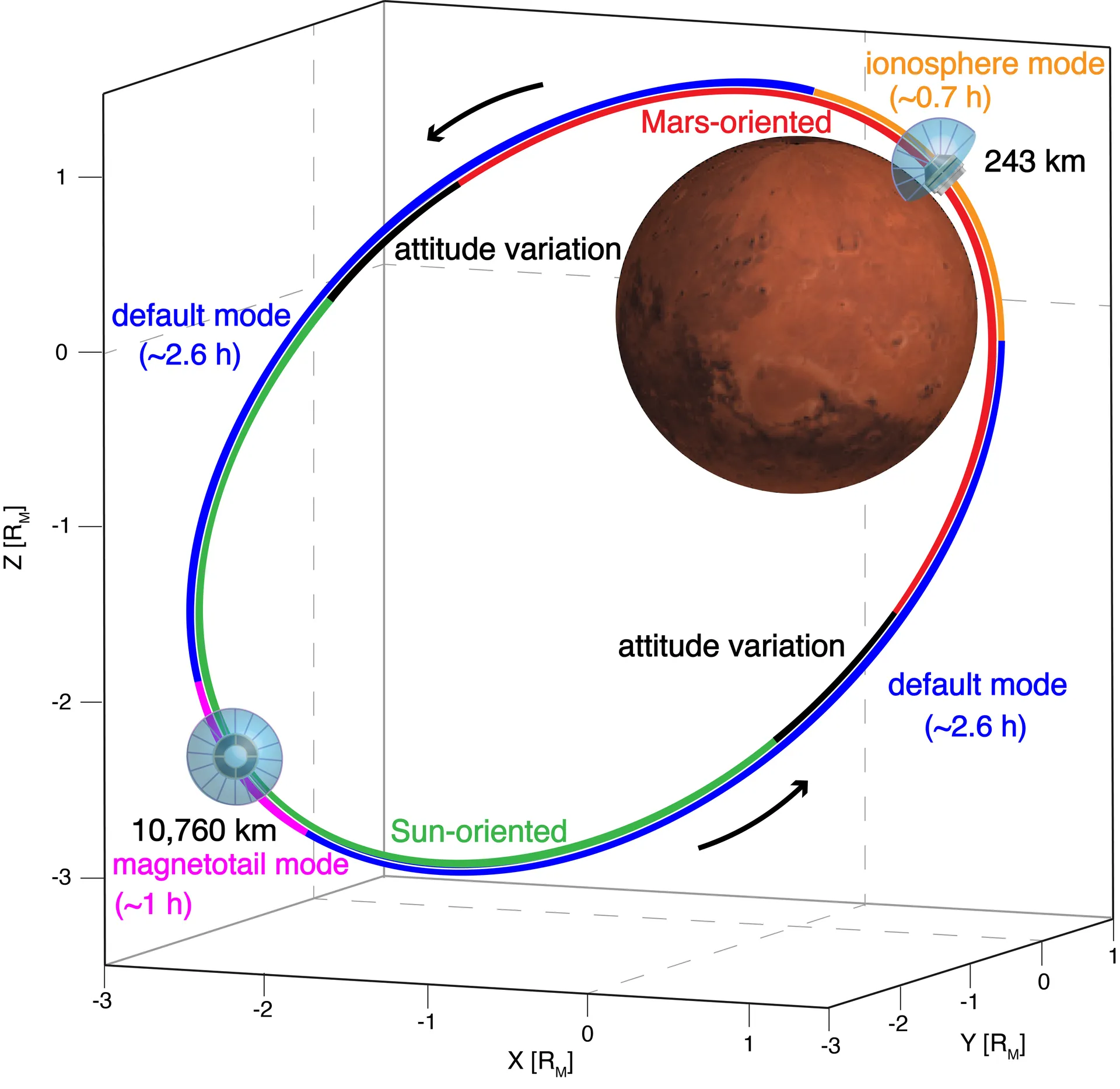
Schematic of Tianwen-1 orbit, attitudes, and MINPA operation modes. The ellipses show the Tianwen-1 orbit (243 X 10,760 km) in the MSO coordinate system.
The inner ellipse represents the attitude references of Tianwen-1 in its regular operation phase. In the apoapsis segment (green), Tianwen-1 is in the Sun-oriented attitude (-Zb points toward the Sun), and MINPA 2 FOV covers -Y hemisphere. In the periapsis segment (red), Tianwen-1 is in the Mars-oriented attitude (+Zb points toward the Mars and +Xb approximately along ram direction). The black curves show the attitude variation phases.
Apoapsis (Green)
Sun-oriented attitude, MINPA 2 FOV covers -Y hemisphere
Periapsis (Red)
Mars-oriented attitude, +Zb points toward Mars
The outer ellipse represents three MINPA operation modes: default (Mode 1: blue), ionosphere (Mode 12: orange), and magnetotail (Mode 4: magenta) modes.
2021-2022 Scientific Observation
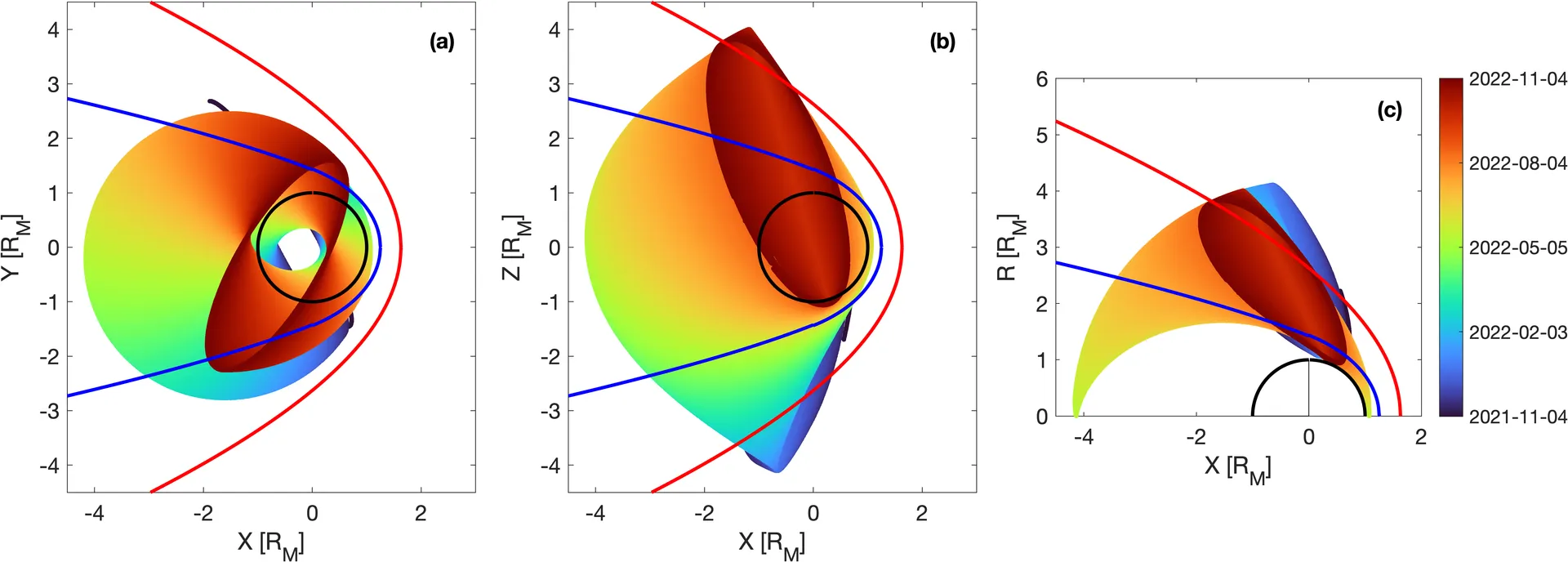
Nearly one-year scientific observation in Mars space environment. MINPA was operated in three different modes: default (Mode 1), magnetotail (Mode 4), and ionosphere (Mode 12).
Orbits of Tianwen-1 spacecraft in (a) X - Y, (b) X - Z, and (c) X - √(Y2 + Z2) planes in MSO coordinates from 2021-11 to 2022-11. The red and blue curves in each panel are empirical bow shock and magnetic pileup boundary (MPB) locations from Trotignon et al. [PSS, 2006].
2023-Present Re-operation
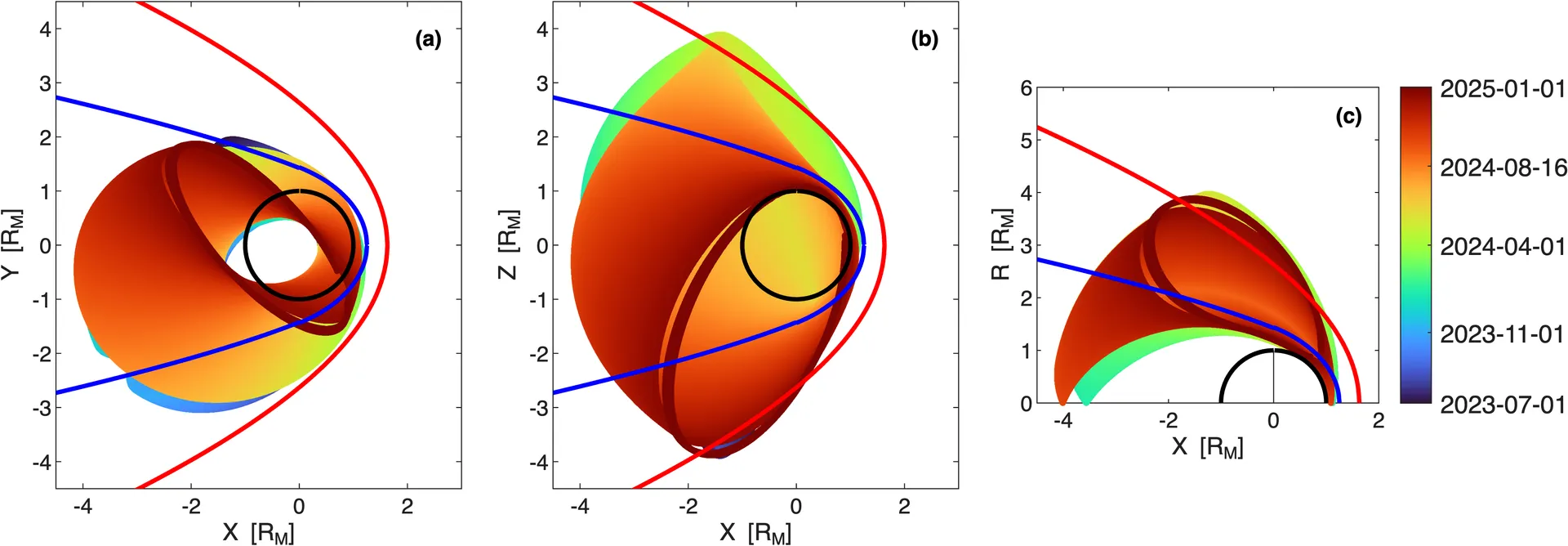
MINPA re-operation phase beginning from June 30, 2023, continuing to present day.
Orbits displayed in X-Y, X-Z, and X-√(Y²+Z²) planes in MSO coordinates from 2023-07 to 2023-09, showing the spacecraft's continued operation in the Mars environment.
About Us
MINPA team members: Linggao KONG (NJU/NSSC), Aibing ZHANG (NSSC), Wenya LI (NSSC), Jijie MA (NSSC/UCAS), Peter Wurz (Univ. Bern), André Galli (Univ. Bern), Binbin TANG (NSSC), Yiteng ZHANG (NSSC), Limin WANG (NSSC), Fuhao QIAO (NSSC), Lei LI (NSSC).
Data Reference and Acknowledgements 数据引用和致谢
The MINPA data used in this website are all from the Lunar and Planetary Data Release Syetem (https://moon.bao.ac.cn/web/zhmanager/home), and the data can be accessed after registration. According to the original data policy, all data users are requested to indicate the source of the data in the research results (including but not limited to journal papers, academic papers, graduation thesis, book monographs, invention patents, project evaluations), and at the same time, the publicly available results should be submitted to China Lunar and Deep Space Exploration Engineering Ground Application System (lpdc@nao.cas.cn) in the form of mail.
Data reference
- Ground Research and Application System of China's Lunar and Planetary Exploration Program. Tianwen-1/MINPA Dataset. China National Space Administration, 2020. http://moon.bao.ac.cn
- 中国月球与深空探测工程地面应用系统. 天问一号MINPA数据集. 中国国家航天局, 2020. http://moon.bao.ac.cn
Acknowledgement
- This data set is processed and produced by "Ground Research and Application System(GRAS)of China's Lunar and Planetary Exploration Program, provided by China National Space Administration (http://moon.bao.ac.cn)".
- 本数据集由中国月球与深空探测工程地面应用系统处理制作,由中国国家航天局提供(http://moon.bao.ac.cn)。
Example
We aknowledge the Tianwen-1 payload team for mission operations and China National Space Administration for providing the Tianwen-1/MINPA data that made this study possible. The MINPA data used in this work is processed and produced by "Ground Research and Application System(GRAS)of China's Lunar and Planetary Exploration Program, it can be accessed at http://moon.bao.ac.cn/ce5web/searchOrder_dataSearchData.search.